
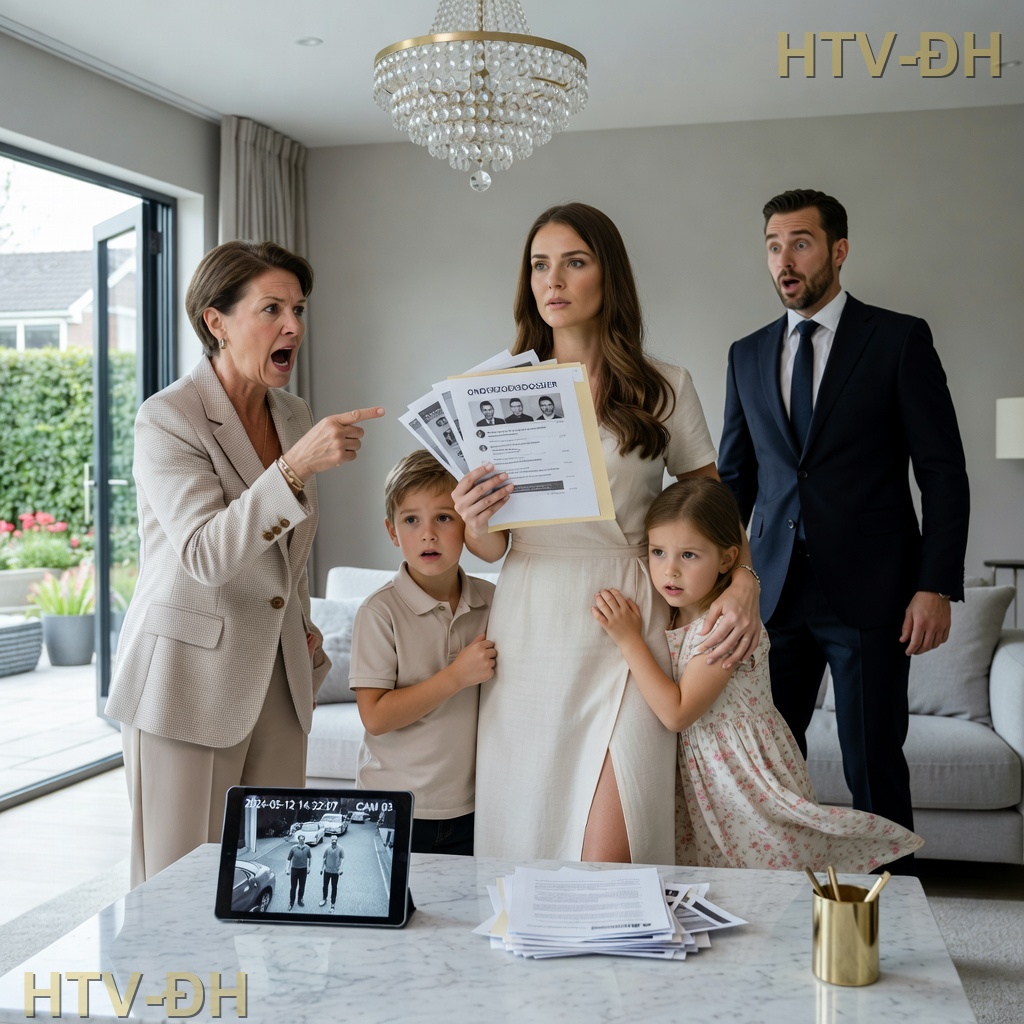
My mother-in-law came to see my children without knowing that her son had abandoned us; she called me incapable in front of everyone, until I showed the file, the cameras, and who tried to take my kids away from me.
“Why did you take down the wedding photo, Mariana? Or are you going to pretend my son disappeared because of you?”
My mother-in-law hadn’t even taken off her beige coat when she threw that question in the middle of my living room. I had Mateo, 8 months old, biting my shoulder because he was teething, and Camila, 4 years old, glued to my leg with a shoeless doll. There was clean laundry on the couch, receipts on the table, a warm bottle next to the TV remote, and 3 sleepless nights etched under my eyes.
Doña Beatriz Alarcón looked at everything like someone inspecting a stranger’s house before condemning it. Her pearls shone brighter than my patience. She scanned the normal chaos of a mother alone with two small children, but her face didn’t see exhaustion. She saw opportunity.
“Rodrigo left 3 weeks ago,” I said.
She stood still. For 1 second, I thought she was going to ask about her grandchildren, about me, about how we were eating, paying bills, breathing. But she clutched her bag against her chest and her expression changed.
“You did something to him.”
It didn’t surprise me as much as it should have. For 7 years of marriage, that woman had treated Rodrigo like a saint exhausted by my existence. He was a lawyer, handsome, well-mannered, one of those men who know how to smile in front of clients and go empty at home. I was 34, a master’s in public health tucked away in a drawer, a career put on hold when Camila was born, and an entire household on my back.
Rodrigo started working late when I was pregnant with Mateo. First it was meetings, then “urgent hearings,” then trips to Saltillo, Torreón, and cities where his firm supposedly had cases. I smelled it before I confirmed it. A different perfume on his shirt. Calls in the yard. Messages he closed quickly. Once I saw the name “Karla M.” on his phone and only managed to read: “I miss you.”
I didn’t cry that night. I had a baby in my belly, a sleeping girl upstairs, and too many things to hold together. Instead of screaming, I opened a digital folder. I gave it a boring name: “vaccines.” There I saved call logs, bank statements, hotel bills, flower receipts, screenshots of messages where he said he was at the office while his card showed dinners in San Pedro. I also saved my own appointment records, daycare payments, prescriptions, pediatric visits, and everything that proved my children were cared for.
It wasn’t coldness. It was survival.
Rodrigo left on a Tuesday. He waited until Camila was at kindergarten and Mateo was asleep. He put his keys on the kitchen counter and told me:
“I need to be happy. You’re strong. You’ll be fine.”
I was holding our baby. He didn’t even have the decency to look at him for long.
“With Karla?” I asked.
His silence answered.
20 minutes after his truck left the gated community, I called my lawyer, Patricia Salgado. I had already consulted her 2 weeks earlier, when I understood that Rodrigo wasn’t just cheating on me, but preparing to leave with a ready-made story.
“We file first,” Patricia told me. “Whoever organizes the facts before the scandal prevents others from inventing the version.”
That’s why, when Doña Beatriz showed up at my house, I had already started the process, requested temporary measures so the children would stay with me, and submitted evidence. She didn’t know it.
“Let me take the children to my house,” she said, looking at the clothes on the couch. “You need to rest. You’re upset.”
Camila squeezed my leg tightly.
“No.”
“I’m not asking you. I’m their grandmother.”
“And I’m their mother.”
Her gaze turned cold.
“If you cooperate, this can be resolved without a scandal. Rodrigo doesn’t need you dragging him down or damaging the Alarcón name.”
That word, “cooperate,” lit a fire inside me. I pulled out my phone.
“Call him.”
She frowned.
“What?”
“Call your son. But first, you should know something: Rodrigo was notified yesterday at his office. The request for temporary custody and child support is already in process.”
The color drained from her face. It wasn’t fear. It was calculation. As if she suddenly realized the board wasn’t where she thought it was.
Rodrigo arrived 14 minutes later, wrinkled shirt, 2-day beard, and the face of a man caught before his time. He walked in without knocking, saw his mother, saw Camila hiding behind me, and Mateo in his high chair.
“You hired lawyers?” he asked.
“You brought another woman into our family.”
Doña Beatriz stepped forward.
“Rodrigo, take the children now.”
“No,” I said.
He raised his voice:
“They’re my children too.”
“Then act like a father.”
Camila looked at Rodrigo with wide eyes.
“Dad, are you coming back to sleep here?”
Rodrigo opened his mouth, but said nothing. Not because it hurt him, but because no answer would leave him looking good. That silence broke something in my daughter. And when Rodrigo’s phone vibrated, he hid it against his chest in panic.
That’s when I knew Doña Beatriz hadn’t come just to visit. She had come to start a war.
What happened next…?
————————————————————————————————————————
“Why did you take down the wedding photo, Mariana? Or are you also going to pretend that my son disappeared because of her?”
My mother-in-law hadn’t even taken off her beige coat when she hurled that question in the middle of my living room. I had Mateo, 8 months old, biting my shoulder because he was teething, and Camila, 4 years old, clinging to my leg with a doll missing a shoe. There was clean laundry on the couch, receipts on the table, a warm bottle next to the TV remote, and 3 sleepless nights etched under my eyes.
Doña Beatriz Alarcón looked at everything like someone inspecting a stranger’s house before condemning it. Her pearls shone brighter than my patience. Her eyes scanned the normal chaos of a mother alone with two small children, but her face didn’t see exhaustion. It saw opportunity.
“Rodrigo left 3 weeks ago,” I said.
She stood still. For 1 second, I thought she was going to ask about her grandchildren, about me, about how we were eating, paying bills, breathing. But she clutched her purse against her chest and her expression changed.
“You did something to him.”
It didn’t surprise me as much as it should have. For 7 years of marriage, that woman had treated Rodrigo like a saint worn down by my existence. He was a lawyer, handsome, educated, one of those men who know how to smile in front of clients and go empty at home. I was 34, a master’s degree in public health stored in a drawer, a career put on hold when Camila was born, and an entire household on my back.
Rodrigo started working late when I was pregnant with Mateo. First it was meetings, then “urgent hearings,” then trips to Saltillo, Torreón, and cities where his firm supposedly had cases. I smelled it before I confirmed it. A different perfume on his shirt. Calls in the yard. Messages he closed quickly. Once I saw the name “Karla M.” on his phone and only managed to read: “I miss you.”
I didn’t cry that night. I had a baby in my belly, a sleeping girl upstairs, and too many things to hold together. Instead of yelling, I opened a digital folder. I gave it a boring name: “vaccines.” There I saved call logs, bank statements, hotel receipts, flower bills, screenshots of messages where he said he was at the office while his card showed dinners in San Pedro. I also saved my own medical visit records, daycare payments, prescriptions, pediatric appointments, and everything that proved my children were cared for.
It wasn’t coldness. It was survival.
Rodrigo left on a Tuesday. He waited until Camila was at kindergarten and Mateo was asleep. He put his keys on the kitchen counter and told me:
“I need to be happy. You’re strong. You’ll be fine.”
I was holding our baby. He didn’t even have the decency to look at him for long.
“With Karla?” I asked.
His silence answered.
20 minutes after his truck left the gated community, I called my lawyer, Patricia Salgado. I had already consulted her 2 weeks earlier, when I understood that Rodrigo wasn’t just cheating on me, but preparing to leave with the story already arranged.
“We file first,” Patricia told me. “Whoever organizes the facts before the scandal prevents others from inventing the version.”
That’s why, when Doña Beatriz showed up at my house, I had already started the process, requested temporary measures so the children would stay with me, and submitted evidence. She didn’t know it.
“Let me take the children to my house,” she said, looking at the clothes on the couch. “You need to rest. You’re upset.”
Camila squeezed my leg tightly.
“No.”
“I’m not asking you. I’m their grandmother.”
“And I’m their mother.”
Her gaze turned cold.
“If you cooperate, this can be resolved without a scandal. Rodrigo doesn’t need you dragging him down or damaging the Alarcón name.”
That word, “cooperate,” lit a fire inside me. I pulled out my phone.
“Call him.”
She frowned.
“What?”
“Call your son. But you should know something first: Rodrigo was notified yesterday at his office. The request for temporary custody and child support is already in process.”
The color drained from her face. It wasn’t fear. It was calculation. As if she suddenly realized the board wasn’t where she thought it was.
Rodrigo arrived 14 minutes later, wrinkled shirt, 2-day beard, and the face of a man caught before his time. He walked in without knocking, saw his mother, saw Camila hiding behind me, and Mateo in his high chair.
“You got lawyers involved?” he asked.
“You brought another woman into our family.”
Doña Beatriz stepped forward.
“Rodrigo, take the children now.”
“No,” I said.
He raised his voice:
“They’re my children too.”
“Then act like a father.”
Camila looked at Rodrigo with wide eyes.
“Daddy, are you going to sleep here again?”
Rodrigo opened his mouth, but said nothing. Not because it hurt him, but because no answer would make him look good. That silence broke something in my daughter. And when Rodrigo’s phone vibrated, he hid it against his chest in panic.
That’s when I knew Doña Beatriz hadn’t come just to visit. She had come to start a war.
PART 2
The campaign started 2 days later. I found out from a mom at Camila’s kindergarten, who wrote to me with embarrassment:
“Mariana, I don’t know how to tell you this, but Doña Beatriz is saying you haven’t been well since Mateo was born.”
The phrase was wrapped in concern, but it smelled like poison. She said my house was “in worrying condition,” that Rodrigo left because I was impossible, that the children needed stability, and that the Alarcón family wanted to “resolve it peacefully.” She didn’t mention Karla. She didn’t mention hotels. She didn’t mention abandonment. Just a tired mother turned into a threat.
I called Patricia at 7:30 in the morning.
“It’s started,” I told her.
“Then we move faster.”
We requested a social worker to review the children’s environment. I went to Mateo and Camila’s pediatrician to update their records. Dr. Sandoval checked weight, vaccines, sleep, eating, and development. At the end, she closed the file and looked me straight in the eye.
“Your children are healthy, well-cared for, and very attached to you. I’m going to put that on record.”
My voice almost broke, but I couldn’t break yet. I had to keep going.
Patricia organized my folder: Rodrigo’s calls to Karla since May, 3,800 accumulated minutes in September, hotel payments when he said he had hearings, flowers that never arrived at my house, messages where he told me “working late today” while he was dining 40 minutes from the office. We also included the medical appointments he never attended: 0 with Mateo, 4 out of 27 with Camila.
The first twist came when Rodrigo’s lawyer presented a photo of my living room as “evidence” of chaos. Toys, clothes, plastic plates. A lived-in living room, not an abandoned one. But the photo was taken from outside, through the window.
I felt ice in my hands.
“Someone entered the gated community and photographed my house.”
Patricia only asked:
“Do you have cameras?”
Yes. Rodrigo always said I was overreacting for installing a camera at the entrance. That night, I blessed it. I checked the video. There was Doña Beatriz, walking along the side garden, leaning toward my window, raising her cell phone.
I sent the file to Patricia.
“Don’t tell anyone,” she replied. “She just handed us gold.”
The second twist came from the school. Doña Beatriz was on the kindergarten fundraising committee and requested a meeting “for the well-being of the Alarcón children.” She thought she could humiliate me there with witnesses. She thought I would arrive crying, disheveled, defenseless.
I arrived in black pants, a white blouse, and a red folder.
In the room were the principal, 5 mothers from the committee, the school mediator, Doña Beatriz, Rodrigo, and, to my surprise, Karla. She stayed in the back, with sunglasses on her head, as if she wanted to watch the fire without getting burned.
Doña Beatriz spoke first.
“We all want what’s best for Camila and Mateo. Mariana is going through a difficult episode. The house is neglected, she doesn’t cooperate, and my son is only trying to protect his children.”
They looked at me. I felt the weight of every judgment.
Rodrigo added:
“I don’t want to take anything away from her. I just want my children to be safe.”
I opened the folder.
“Then let’s start with the truth.”
I put on the table the pediatrician’s report, the kindergarten records, the payments, the vaccines, the appointments, the routines. Then I pulled out the first hotel receipt.
“And then we’ll talk about who abandoned the house.”
Karla stood up abruptly.
“Rodrigo, you told me you were already separated before the baby was born.”
The room went silent. Doña Beatriz turned to her son. Rodrigo went pale.
I plugged my USB into the room’s screen.
“And now you’re going to see who took the illegal photo of my window.”
The video started right when Doña Beatriz appeared entering my garden.
Hello, dear readers! If you’re ready to read the Final Part, let me know in the comments section, and I’ll send it right away. May God always grant you health and happiness!
FINAL PART
On the screen, Doña Beatriz walked slowly along the side of my house. She stopped in front of the window, looked both ways, and raised her cell phone to photograph my living room. The silence in the kindergarten room was louder than any scream.
The principal crossed her arms.
“Doña Beatriz, did you take that photo?”
My mother-in-law lifted her chin.
“I was worried about my grandchildren.”
“You entered my garden without permission,” I said. “You photographed my house and then used that image to say my children were at risk.”
Rodrigo tried to intervene.
“My mom was just trying to help.”
Patricia, who had been sitting quietly beside me, placed a sheet on the table.
“Worry doesn’t justify invading a property or fabricating a narrative. This behavior has already been added to the case file.”
Doña Beatriz looked at Rodrigo as if expecting him to take control. But he didn’t know what to say. Karla did.
“He lied to me too,” she said, her voice trembling. “He told me Mariana couldn’t take care of the children, that the separation was mutual, and that his mom was helping him because she was unstable.”
Rodrigo glared at her.
“Shut up, Karla.”
That “shut up” finished showing who he was. Not a worried father. A man losing control over all the women he had used.
I pulled out another document.
“Here are the call logs. In September, when Mateo was weeks old, Rodrigo talked to Karla for 3,800 minutes. With me, 42. Here are the hotels. Here are the dinners. Here are the messages where he told me he was in a hearing. And here are the medical appointments for our children.”
The principal looked at Rodrigo.
“Mr. Alarcón, you requested that we review Camila’s school well-being based on information that now appears incomplete.”
“This is private,” he said.
“My children aren’t private when you try to use them as punishment.”
Doña Beatriz slammed her palm on the table.
“You destroyed my family!”
I looked at her without blinking.
“No, ma’am. I’m raising what your son abandoned.”
One of the mothers on the committee looked down. Another murmured:
“How shameful.”
She didn’t say it about me.
The school mediator closed his notebook.
“The school will not participate in family pressure. Any communication about Camila will be solely with her authorized parents and through official channels.”
That was the first real victory. Small, but clean.
The second came 2 weeks later, at the temporary hearing. The social worker’s report confirmed that my house was adequate, the children were healthy, and Camila showed secure attachment to me. The pediatrician’s report backed it up. The window photo was used against them. Doña Beatriz’s attempt to paint me as an incapable mother was recorded as invasive behavior.
The judge granted primary residence to me, scheduled visits for Rodrigo, child support calculated on his real income, and a clear clause: no family member could show up at my house, school, or medical appointments without consent.
Doña Beatriz was mentioned by name.
When Patricia read me that part, I was sitting on the floor of my kitchen, with Mateo asleep on the monitor and Camila singing in the bathroom.
“They mentioned her,” I whispered.
“Yes,” Patricia said. “And that carries weight.”
That night, I made quesadillas, bathed the kids, read 2 stories, and sat on the edge of Camila’s bed until she fell asleep. I didn’t celebrate with wine. I didn’t post anything on social media. I just breathed. Sometimes a mother’s victory doesn’t make noise. Sometimes it’s simply closing the door and knowing no one can come in and take your children away.
Rodrigo tried to see me the next day. He arrived at the gated community’s entrance with flowers and a face I didn’t recognize: tired, dull.
“Mariana, we need to talk.”
“Talk.”
I didn’t open the gate.
“My mom went too far.”
“Your mom did what you allowed her to do.”
He looked down.
“Karla left. She says she doesn’t want to be part of this.”
“What a surprise. A woman who didn’t want to carry your lies.”
“Don’t be cruel.”
I almost smiled.
“Cruel was leaving an 8-week-old baby and a 4-year-old girl to go sleep with another woman. Cruel was letting your mother call me incapable. Cruel was using your children as a strategy.”
He was silent.
“I want to fix it.”
“There’s no marriage to fix.”
“And my children?”
“Your children need a father, not a lawyer for your own lies.”
His eyes welled up.
“Camila looks at me like I’m a stranger.”
“Because you left like one.”
I didn’t say more. I hung up the intercom and went inside. My hands were shaking, but this time not from fear. They were shaking because my body finally understood that it no longer had to negotiate its peace with someone who had broken everything.
5 months passed. I started taking on community health consulting projects from home. Camila started play therapy, and one day she drew a house with 3 windows, 2 children, and a huge mom in the center.
“And Daddy?” the therapist asked carefully.
Camila thought for a moment.
“He’s on another page.”
I cried in the car afterward, but not from defeat. I cried because my daughter was no longer trapped in the middle of the drawing.
Doña Beatriz called one March morning. I answered because the agreements were already clear and because I no longer feared her voice.
“Mariana,” she said, lower than ever. “I want to ask for your forgiveness for what I said that day.”
I didn’t fill the silence for her.
“I shouldn’t have said you provoked it. I shouldn’t have tried to take the children.”
I looked at the cold coffee cup on the table.
“Thank you for saying that.”
“I want to see them.”
“Talk to Rodrigo. Everything is in the plan. If he complies, there will be opportunities. If he doesn’t, there won’t.”
I expected an argument. It didn’t come.
“I understand,” she said.
I hung up and kept working. Mateo woke up from his nap, Camila came home from kindergarten with glitter in her hair, and life went on, messy, demanding, alive.
The living room filled with toys again. The laundry stayed on the couch some afternoons. There were dishes, backpacks, bottles, drawings taped to the refrigerator. But no one could look at my house anymore and turn my exhaustion into guilt.
Rodrigo had left an empty frame on the bookshelf. I didn’t put our photo back. In its place, I put a picture of Camila carrying Mateo, both of them laughing at Fundidora Park.
That was my family now. Not perfect. Not quiet. Not easy. But mine, protected, and standing.
If a mother-in-law tried to use your exhaustion as a mother to take your children away, would you confront her in public or let the truth speak with evidence?
I wish much health and happiness to everyone who has read and loved this story!